
On the occasion of World Mission Sunday on 18 October 2026, Fr. Minh Quang Nguyen, Diocesan Director of Missio Denmark, reflects on what mission really is.
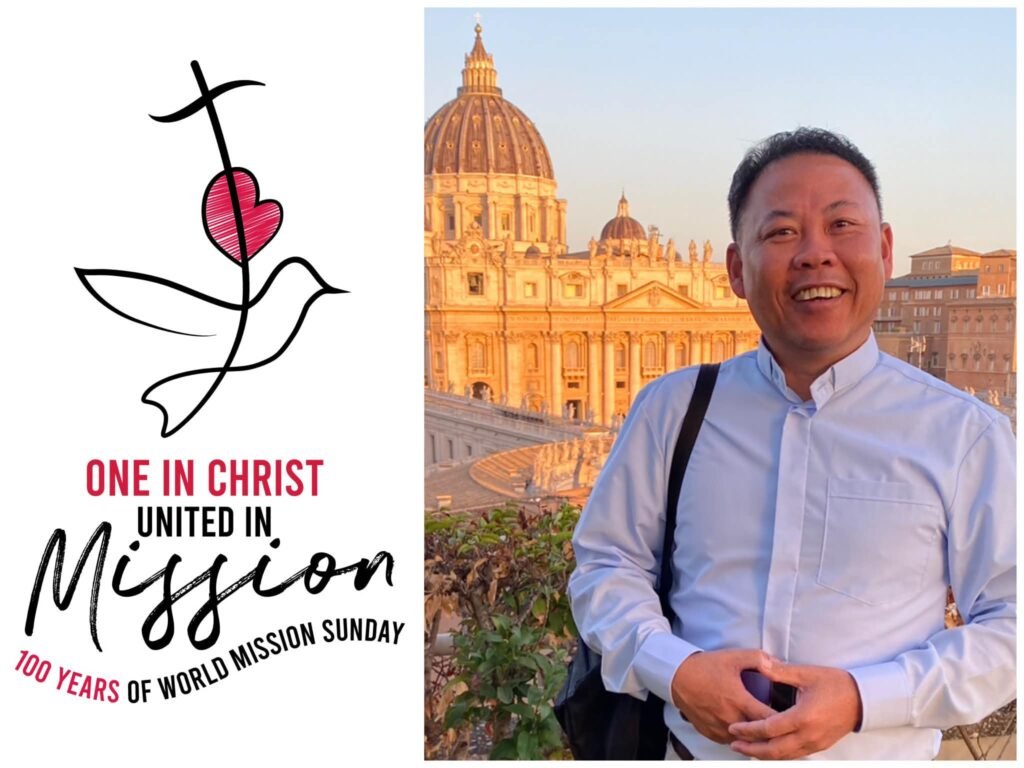
Father Minh Quang Nguyen is the Diocesan Director of Missio Denmark and the parish priest of Sankt Andreas og Sankt Therese parish in Hellerup.
This year, we celebrate the 1,200th anniversary of Saint Ansgar’s mission to Denmark. He was a key figure in Denmark’s Christian history and the patron saint of the Diocese of Copenhagen. It is therefore a fitting opportunity to reflect on the meaning of mission.
As Diocesan Director of Missio Denmark, I am often asked about the nature of mission. What is mission? What do missionaries actually do? And why? As we mark the 100th anniversary of World Mission Sunday, this seems an appropriate time to share some answers to these fundamental questions, which lie at the heart of Missio’s work.
What is mission?
Mission is about proclaiming God’s love and God’s Kingdom by sharing the gift of faith and through teaching. We are all invited to take part in mission, and we are all called to welcome it into our lives.
Jesus said: “Go therefore and make disciples of all nations…” (Matthew 28:19). This does not mean forcing anything upon anyone. Rather, it means giving people the opportunity to engage, or not. A good teacher, whatever the field, gives students the chance to hear the information, understand it, and make their own choices. That is precisely what we do as missionaries.
We proclaim, we share, we bear witness to Jesus Christ and His Gospel, and then it is up to people to respond as they wish. Whatever their response may be, they remain loved.
What do missionaries actually do?
As we know, and as both Pope Francis and Pope Leo have emphasized, anyone who is baptized is automatically a missionary. Wherever we are, we are called to proclaim and bear witness to the coming of God’s Kingdom, in word and deed.
How does one do this in a foreign culture, in a foreign country? First and foremost, one goes there with respect. One goes willing to learn. One goes to listen. One goes to learn the language and understand local customs. One goes to love the people. It is through all of this that one bears witness to God’s love and the coming of His Kingdom.
When a missionary arrives in a new place, much time and energy are devoted to understanding the situation, understanding the culture, and communicating with people. Relationships are built. It is only through relationships that people can be led to Christ and helped to understand what God’s Kingdom is about, what Jesus’ message is, and who Jesus is.
This may mean simply being present in a village, as many missionaries have done, for example by visiting families, spending time with people, sharing meals, and talking together. One talks about life, and if people wish, one talks about Jesus Christ, the Church, and the Kingdom of God.
It may also involve organizing projects that help people. The Church is, of course, well known for its educational work. Around the world, missionaries often began by establishing schools that provided education. We continue to do so today. Even in countries where the Christian presence is very small, there are hundreds of schools that are deeply appreciated by local communities. This is one way of reaching out.
Another way is through local healthcare, serving villages where organized healthcare is unavailable. In general, missionaries try to respond to what people genuinely need.
There is, however, a danger. A missionary, like a priest, may arrive somewhere and say: “I know what you need.” Perhaps: “You need a church, a parish hall, a pharmacy, a school.” All these things may be excellent, but mission is not about what I think people need. One must sit down and listen and ask: “What do you need? What do you think you need?”
Sometimes the answers are surprising, and rightly so, because people may see life differently from the way I do. Different does not mean better or worse, simply different. Therefore, I stress that a missionary’s first task is to listen, to observe, and to learn, guided by the Holy Spirit. We are not here to solve all the world’s problems. God will do that in God’s own time.
In the meantime, we are here to show that God truly cares about what is happening and that He calls all of us to work together to build a better, more just, and more peaceful world. And that this is possible.
Isn’t the Church in Asia and Africa doing well on its own now?
It is widely recognized that the Church in Africa is flourishing, growing rapidly, and expanding in many countries, especially in sub-Saharan Africa.
In Asia, there are places where the Church is well established and thriving. One can think of countries such as the Philippines, where missionaries arrived centuries ago. Yet there are other places, such as Mongolia, where missionary activity only truly began about thirty years ago. The picture is therefore mixed.
It is important to remember, especially in Africa, where many missionaries have worked, that although enthusiasm for the Church is great, many local Churches are still very young, perhaps only 100, 120, or 130 years old. They are still establishing themselves. They continue to benefit from the wisdom, experience, and sometimes resources of older Churches, particularly in Europe, whose history stretches back many centuries. We still have a role to play there, just as they have a role to play here.
Across Europe, for example, many migrants settle in our countries and bring with them their experience of the Catholic faith. They enrich our Church. We now have priests from many parts of the world, especially from Africa, serving in Europe and helping to address the shortage of priests. In this sense, mission is a two-way exchange.
In simple terms, missionaries went to Africa and Asia and helped establish the Church there. Today, some of those countries, despite facing their own shortages of priests and religious, are able to send missionaries and personnel to support older Churches. I see this as wholly positive, because we enrich one another. Whenever we encounter another culture and another people, we ourselves are enriched by that encounter.
Just as we sometimes influence those we meet, work with, and live alongside, they influence us in return. There is a reciprocity grounded in respect and openness.
Why support the Church abroad when there is so much need at home?
I understand when people ask me personally: “Why do you go abroad as missionaries when there is so much to do here? There are people suffering here, people living in poverty, people who do not know Jesus Christ. Why go abroad?”
First of all, it is not really my choice. Jesus said: “Go therefore and make disciples of all nations.” In other words, go out and share the Gospel with all peoples everywhere. Reach out to them. This has been the Church’s mission from the very beginning, from the moment the disciples received the Holy Spirit at Pentecost. It was about going out to proclaim the coming of God’s Kingdom, and it still is.
To put it plainly, Jesus did not say: “If possible, go,” or “Stay at home unless necessary, but if you can, then go to other nations.” He simply said: “Go.” It is not our choice; we follow the teaching of Jesus Christ.
That said, I fully recognize that there is much work to be done at home. There are two kinds of mission: mission at home and mission abroad.
They are quite different. At home, the goal is often to renew Christian culture, deepen Christian understanding, and strengthen the local Church. This is something in which all of us are involved. As I live in Denmark and share with people what mission is, I am also evangelizing here.
We are called to share what we have with one another. That does not mean money alone, although money is certainly part of it. The first Christian communities held everything in common and helped one another whenever possible.
We may not do that in exactly the same way today because our communities are much larger, but the principle remains the same: to share what we have. Not only our money, important though that is, but also our understanding of the Gospel, our relationship with Jesus Christ, our time, kindness, compassion, sense of justice, and our efforts to build a peaceful world free from violence and war. All these wonderful principles that Jesus gave us, His vision of a new world, are meant to be shared with everyone.
This means that some people are called to go abroad physically. By doing so, they continue Christ’s call to go to all nations, teach them, share God’s love with them, and help them understand what it means, for in this we find salvation.
Does mission simply mean imposing Western Catholicism on other cultures?
Mission can never be about imposing anything on anyone. When we go to a mission country, we are foreigners and therefore guests. We are guests of the people who have welcomed us or perhaps even invited us to come. Pope Benedict said that the Church does not grow by imposing itself. It grows by attraction. This means that people come to know Jesus Christ and understand His Kingdom by seeing others strive to live it and by being drawn to it; drawn to communities and people who are open, kind, compassionate, committed to justice, working for peace, and striving for greater equality in society.
All these characteristics of God’s Kingdom attract people. This is where what we call conversion takes place. You cannot convert someone by force. How could you? It would be like saying: “I want you to love me.” It does not work that way. We cannot make people love Jesus Christ. We must love Him ourselves and allow others to see that love and respond as they wish.
And all of this requires trust, trust and faith in the Holy Spirit. It is the Holy Spirit who is at work in all of this. It is not only about us. We are trying to do God’s work, but ultimately it is God’s work, not mine and not yours.
Fr. Minh Quang Nguyen