
Biblical missionary commentary for the EASTER TRIDUUM 2026 by Father Dinh Anh Nhue Nguyen, Secretary General of the Pontifical Missionary Union.
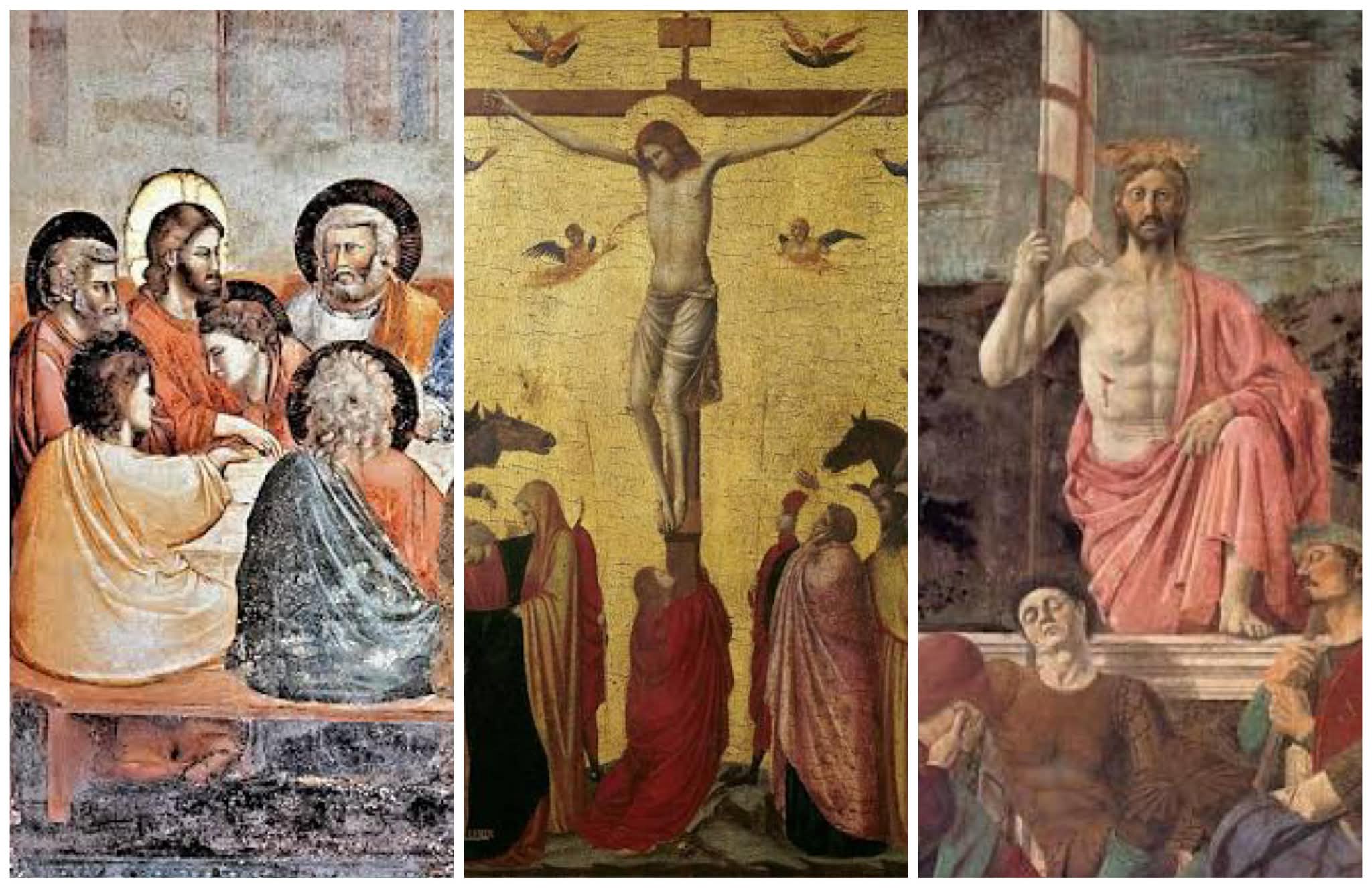
As we enter the Easter Triduum, I would like to remind what has been underlined in the commentary for Palm Sunday: “[The liturgical celebration of the Holy Week and Triduum] is not simply a remembrance of what happened in the past, but a realization of the mystery of Jesus’ passion, death and resurrection for us in the present. We are called to relive these events, to participate in them, moreover, to die to ourselves for a new life in Christ and in God. It will therefore be fundamental to listen attentively and humbly to the Word of God that speaks abundantly to us (…) in the readings as well as in various liturgical prayers. It is also necessary to have an attitude of personal reflection and meditation on what has been heard, to enter into the depths of the mystery being celebrated.”
“The spiritual richness of Jesus’ Passion is immense for Christian life and mission. What I share with you for these special days of Holy Week is just some introductory notes, which hopefully may invite all to deeper personal reflection and meditation upon its meaning for us.” Therefore, my intention will simply be to let Jesus speak with His words and actions that should be dear to every disciple of His.
That being said, I humbly lay out a few thoughts on Jesus’ last desire, last word, and last action which particularly struck me.
1. The Last Desire of Jesus (Holy Thursday)
On this holy day, we enter into the mystery of the Eucharist’s institution with fresh memory of what we have heard from the reading of Jesus’ Passion on Palm Sunday. From the account of Saint Luke a detail gives us a glimpse of Jesus’ particular sentiment at the beginning of the Last Supper. He said to his disciples: “I have eagerly desired to eatthis Passoverwith you before I suffer, for, I tell you, I shall not eat it [again] until there is fulfillment in the kingdom of God” (Lk 22:15-16). Here is his last desire before His passion and death. It is expressed in a peculiar grammatical structure of redundancy in the Greek original: epithymia epethymêsa (lit. “I desired the desire”). Such a construction actually reflects the Hebrew/Aramaic way of speaking (that of Jesus), used to emphasize a very strong desire of the heart – I desired fervently.
This phrase of Jesus, in its style, echoes the statement He made during His public ministry: “There is a baptism with which I must be baptized, and how great is my anguish until it is accomplished!” (Lk 12:50). Here, too, we see Jesus’ mind and heart all geared toward His passion and death as the culmination of His mission, that “hour” when He will be baptized/immersed in blood, and drink the cup of the Father. This ardent desire of Jesus to “eat” the Passover with his disciples comes from his great zeal to faithfully fulfill the mission entrusted to Him by the Father. On the other hand, contained in this desire is all the importance of the Last Supper event, which is intrinsically linked with the moment of the Cross, because at this meal Jesus will establish once and for all the Eucharist, the rite of the New Covenant in His blood (cf. 1 Cor 11:25). It is, therefore, His great desire that His “apostles” participate in His mission and Passion.
Everything is immersed in the perspective of the realization of the Kingdom of God. In fact, Jesus solemnly declares: “[Because] I shall not eat it [again] until there is fulfillment in the kingdom of God” (Lk 22:16) and, then, “from this time on I shall not drink of the fruit of the vine until the kingdom of God comes” (Lk 22:18). These statements are mysterious in some ways, but they sound actually like a solemn oath of a consecrated person of God in making a vow to perform some sacred action (cf. Nm 6:2-4). Jesus, the anointed and consecrated one of God, will do everything, or rather, he will do the supreme act of all things, sacrificing Himself, for the coming of the Kingdom of God.
Will the disciples of that time have understood or sensed such a strong feeling of their Master and His zeal? And do we, His modern disciples, today as every time we are at the Eucharist (at Mass), feel such a burning desire of Jesus to eat this Passover with us? He still wants, mystically but always ardently, to have this Passover supper with His disciples in order to share again with each of them all of Himself, body, blood, life, passion, mission. To feel this desire of Jesus will surely be fundamental for each of His disciples to continue Jesus’ own mission with the same zeal to accomplish the will of the Father despite everything. “For as often as you eat this bread and drink the cup, you proclaim the death of the Lord until he comes” (1Cor 11: 26).
2. The Last Word of Jesus (Good Friday) (and His Priestly Prayer)
“It is finished.” (Jn 19:30). This is the last sentence of Jesus before he died according to the passion account in the Gospel of John that we hear every Good Friday. In the original Greek, it is a verb in the perfect, tetelestai, which literally means, “it has reached the end.” This word is wonderfully connected (and perhaps intentionally by the evangelist) with what was stated at the beginning of the account of the passion that we heard in the Gospel of Holy Thursday: “Before the feast of Passover, Jesus knew that his hour had come to pass from this world to the Father. He loved his own in the world and he loved them to the end” (Jn 13:1).
The fulfillment of the whole mission of Jesus came under the sign of love. This is true both quantitatively (up to the last moment of life) and qualitatively (up to the supreme act of dying for his friends / loved ones). In Jesus on the cross, love has reached the height of its measure which is precisely love without measure (to repeat an aphorism of St. Augustine). From this perspective, we understand what Jesus himself had declared: “And when I am lifted up from the earth, I will draw everyone to myself” (Jn 12:32). His is the mission in love. Indeed, it is love in mission!
As the second reading of Good Friday reminds us, “[Christ, in fact,] in the days when he was in the flesh, he offered prayers and supplications with loud cries and tears to the one [God] who was able to save him from death” (Heb 5:7). Of all these prayers, there is one particularly to meditate and repeat especially during the Holy Triduum. This is the so-called priestly prayer of Jesus in Jn 17 (which unfortunately is not read in the liturgy). It expresses the whole profound meaning of the passion and death of Jesus and, at the same time, reveals the whole missionary dimension of Jesus’ existence as well as the loving heart for his disciples of all times: that they may be united in love like him with the Father, so that the world may believe in him as the One sent by the Father. It will therefore be important for every missionary disciple of Jesus to put these words of the Master to heart, to learn them by heart, in order to pray with them often, particularly in these holy days.
3. The Last Act of Jesus (Waiting for the Resurrection)
Also in the Passion account according to St. John, after uttering the mentioned last word, “bowing his head, he handed over the spirit.” Here we have another theological subtlety to emphasize, even if some modern translations of the gospel do not highlight it. The phrase may simply indicate Jesus’ act of dying, exhaling His last breath (a simple “he expired”). Nevertheless, such a construction of the sentence also implies an action of giving/donating the spirit that is in Jesus. In the evangelist’s profound theological vision, Jesus’ last breath is His final action of handing over/giving/donating to the world, indeed to the universe, His own spirit for a new creation: “Behold, I make all things new” (Rev 21:5). As in the creation of the world, the Spirit of God swept over primordial and permeated the earth without form or shape (cf. Gen 1:1-2), so now from the height of the Cross on Calvary, the Spirit fills the universe once again, the one deformed now because of sins, to signal already the dawn of a new history, even if everything was still in darkness waiting for the Light that shines (just like at the beginning of the first creation).
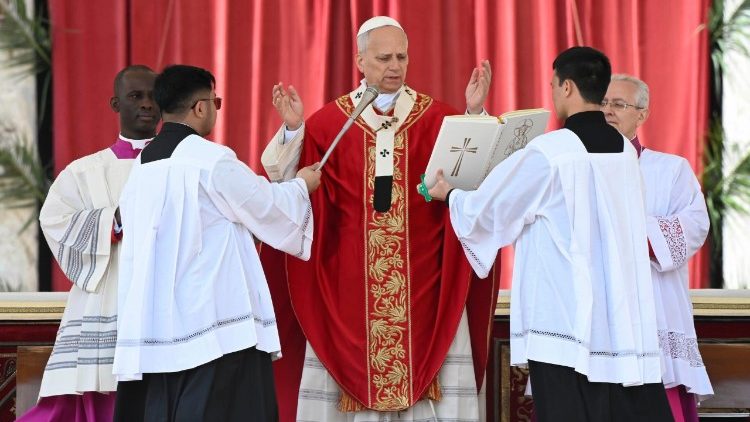
Pope Leo XIV on Palm Sunday. Photo: Vatican News.
USEFUL POINTS TO CONSIDER
- Leo XIV,General Audience, St. Peter’s Square, Wednesday, 6 August 2025
Cycle of Catechesis – Jubilee 2025. Jesus Christ our Hope. III. The Passover of Jesus. 1. The preparation of the supper. “Make the preparations for us there” (Mk 14:15)
[…] The Eucharist is not celebrated only at the altar, but also in daily life, where it is possible to experience everything as an offering and giving of thanks. To prepare to celebrate this thanksgiving does not mean doing more, but leaving room. It means removing what encumbers us, reducing our demands and ceasing to hold unrealistic expectations. Indeed, too often we confuse preparations with illusions. Illusions distract us; preparations guide us. Illusions seek a result; preparations make an encounter possible. True love, the Gospel reminds us, is given before it is reciprocated. It is an anticipatory gift. It is not based on what is received, but on what one wishes to offer. It is what Jesus lived with his disciples: while they still did not understand, while one of them was about to betray him and another to deny him, he was preparing a communion supper for them all.
Dear brothers and sisters, we too are invited to “prepare the Passover” of the Lord. Not only the liturgical one: that of our life too. Every gesture of willingness, every gratuitous act, every forgiveness given in advance, every effort patiently accepted, is a way to prepare a place where God can dwell. […]
If we accept the invitation to prepare the place of communion with God and among ourselves, we will discover we are surrounded by signs, encounters and words that guide us towards that room, spacious and already prepared, in which the mystery of an infinite love, sustaining us and always preceding us, is celebrated unceasingly. May the Lord grant us to be humble preparers of his presence. And, in this daily readiness, may that serene trust also grow in us, allowing us to face everything with a free heart. Because where love has been prepared, life can truly flourish.
2. Leo XIV,General Audience, Audience Hall, Wednesday, 27 August 2025
Cycle of Catechesis – Jubilee 2025. Jesus Christ our Hope. III. The Passover of Jesus. 4. The surrender. ‘Whom are you looking for?’ (Jn 18:4)
[…] Today we will focus on a scene that marks the beginning of the Passion of Jesus: the moment of his arrest in the Garden of Olives. The evangelist John, with his usual depth, does not present a frightened Jesus who flees or hides. On the contrary, he shows us a free man, who comes forward and speaks, openly facing the hour in which the light of the greatest love can be revealed.
“Jesus, knowing all that was to befall him, came forward and said to them, ‘Whom do you seek?’” (Jn 18:4). Jesus knows. However, he decides not to retreat. He gives himself up. Not out of weakness, but out of love. A love so full, so mature, that it does not fear rejection. Jesus is not seized: he lets himself be taken. He is not the victim of an arrest, but the giver of a gift. In this gesture, he embodies a hope of salvation for our humanity: to know that, even in the darkest hour, one can remain free to love to the end.
When Jesus replies, “I am he”, the soldiers fall to the ground. It is a mysterious passage, since this expression, in biblical revelation, recalls the very name of God: “I am”. Jesus reveals that God’s presence is manifested precisely where humanity experiences injustice, fear, loneliness. Right there, the true light is ready to shine without fear of being overcome by the advancing darkness.
In the middle of the night, when everything seems to be falling apart, Jesus shows that Christian hope is not evasion, but decision. This attitude is the result of profound prayer in which God is not asked to spare us from suffering, but rather to give us the strength to persevere in love, knowing that life offered freely for love cannot be taken away by anyone.
“If you seek me, let these men go” (Jn 18:8). At the time of his arrest, Jesus does not worry about saving himself: he wishes only for his friends to go free. This shows that his sacrifice is a true act of love. Jesus lets himself be taken and imprisoned by the guards only so that his disciples may be set free.
[…]
3. Leo XIV,General Audience, St. Peter’s Square, Wednesday, 17 September 2025
Cycle of Catechesis – Jubilee 2025. Jesus Christ our Hope. III. The Passover of Jesus. 7. Death. “In the garden was a new tomb, in which no one had yet been buried.” (Jn 19:40-41)
[…]In our journey of catechesis on Jesus our hope, today we will contemplate the mystery of Holy Saturday. The Son of God lies in the tomb. But this “absence” of his is not emptiness: it is expectation, a restrained fullness, a promise kept in the dark. It is the day of the great silence, in which the sky seems mute and the earth immobile, but it is precisely there that the deepest mystery of the Christian faith is fulfilled. It is a silence laden with meaning, like the womb of a mother who carries her unborn but already living child.
The body of Jesus, taken down from the cross, is carefully wrapped, as one does with something precious. John the Evangelist tells us that he was buried in a garden, inside “a new tomb where no one had ever been laid” (Jn 19:41). Nothing is left to chance. That garden recalls the lost Eden, the place where God and man were united. And that tomb, never used, speaks of something that has still to happen: it is a threshold, not an end. At the beginning of creation, God planted a garden; now the new creation also begins in a garden: with a closed tomb that will soon be opened.
Holy Saturday is also a day of rest. According to the Jewish Law, no work is to be done on the seventh day: indeed, after the six days of creation, God rests (cf. Gen 2:2). Now, the Son too, after completing his work of salvation, rests. Not because he is tired, but because he loved up to the very end. There is nothing left to add. This rest is the seal on the completed task; it is the confirmation that what should have been done has truly been accomplished. It is a repose filled with the hidden presence of the Lord.
We struggle to stop and rest. We live as if life were never enough. We rush to produce, to prove ourselves, to keep up. But the Gospel teaches us that knowing how to stop is an act of trust that we must learn to perform. Holy Saturday invites us to discover that life does not always depend on what we do, but also on how we know how to take leave of what we have been able to do.
In the tomb, Jesus, the living Word of the Father, is silent. But it is precisely in that silence that the new life begins to ferment. Like a seed in the ground, like the darkness before dawn. God is not afraid of the passing time, because he is also the God of waiting. Thus, even our “useless” time, that of pauses, emptiness, barren moments, can become the womb of resurrection. Every silence that is welcomed can be the premise of a new Word. Every suspended time can become a time of grace, if we offer it to God. […]
4. Leo XIV,General Audience, Audience Hall, Wednesday, 20 August 2025
Cycle of Catechesis – Jubilee 2025. Jesus Christ our Hope. III. The Passover of Jesus. 3. Forgiveness. «He loved them to the end» (Jn 13:2)
[…] Today we will look at one of the most striking and luminous gestures in the Gospel: the moment when Jesus, during the last supper, offers a morsel to the one who is about to betray him. It is not only a gesture of sharing: it is much more; it is love’s last attempt not to give up.
Saint John, with his profound spiritual sensibility, tells us about this moment as follows: [During supper, when] “the devil had already induced Judas, son of Simon the Iscariot, to hand him over… Jesus knew that his hour had come to pass … he loved them to the end” (Jn 13:1-2). To love until the end: here is the key to understanding Christ’s heart. A love that does not cease in the face of rejection, disappointment, even ingratitude.
Jesus knows the time, but he does not submit to it: he chooses it. It is he who recognizes the moment in which his love must pass through the most painful wound, that of betrayal. And instead of withdrawing, accusing, defending himself… he continues to love: he washes the feet, dips the bread and offers it. […]
Judas, unfortunately, does not understand. After the morsel – says the Gospel – “Satan entered him” (v. 27). This passage strikes us: as if evil, hidden until then, manifested itself after love showed its most defenceless face. And precisely for this reason, brothers and sisters, that morsel is our salvation: because it tells us that God does everything – absolutely everything – to reach us, even in the hour when we reject him.
It is here that forgiveness reveals all its power and manifests the true face of hope. It is not forgetfulness; it is not weakness. It is the ability to set the other free, while loving him to the end. Jesus’ love does not deny the truth of pain, but it does not allow evil to have the last word. This is the mystery Jesus accomplishes for us, in which we too, at times, are called to participate. […]
5. From a homily by Saint Gregory Nazianzen, bishop (Oratio 45, 23-24: PG 36, 654-655)
We are soon going to share in the Passover, and although we still do so only in a symbolic way, the symbolism already has more clarity than it possessed in former times because, under the law, the Passover was, if I may dare to say so, only a symbol of a symbol. Before long, however, when the Word drinks the new wine with us in the kingdom of his Father, we shall be keeping the Passover in a yet more perfect way, and with deeper understanding. […]
So let us take our part in the Passover prescribed by the law, not in a literal way, but according to the teaching of the Gospel; not in an imperfect way, but perfectly; not only for a time, but eternally. Let us regard as our home the heavenly Jerusalem, not the earthly one; the city glorified by angels, not the one laid waste by armies. We are not required to sacrifice young bulls or rams, beasts with horns and hoofs that are more dead than alive and devoid of feeling; but instead, let us join the choirs of angels in offering God upon his heavenly altar a sacrifice of praise. We must now pass through the first veil and approach the second, turning our eyes toward the Holy of Holies. I will say more: we must sacrifice ourselves to God, each day and in everything we do, accepting all that happens to us for the sake of the Word, imitating his passion by our sufferings, and honoring his blood by shedding our own. We must be ready to be crucified.
If you are a Simon of Cyrene, take up your cross and follow Christ. If you are crucified beside him like one of the thieves, now, like the good thief, acknowledge your God. For your sake, and because of your sin, Christ himself was regarded as a sinner; for his sake, therefore, you must cease to sin. Worship him who was hung on the cross because of you, even if you are hanging there yourself. Derive some benefit from the very shame; purchase salvation with your death. Enter paradise with Jesus, and discover how far you have fallen. Contemplate the glories there, and leave the other scoffing thief to die outside in his blasphemy.
If you are a Joseph of Arimathea, go to the one who ordered his crucifixion, and ask for Christ’s body. Make your own the expiation for the sins of the whole world. If you are a Nicodemus, like the man who worshiped God by night, bring spices and prepare Christ’s body for burial. If you are one of the Marys, or Salome, or Joanna, weep in the early morning. Be the first to see the stone rolled back, and even the angels perhaps, and Jesus himself.
READINGS
HOLY THURSDAY
EVENING MASS OF THE LORD’S SUPPER
Ex 12:1-8,11-14; Ps 116; 1Cor 11:23-26; Jn 13:1-15
GOOD FRIDAY OF THE LORD’S PASSION
Is 52:13-53:12; Ps 31; Heb 4:14-16; 5:7-9; Jn 18:1-19:42
HOLY SATURDAY AT THE EASTER VIGIL IN THE HOLY NIGHT OF EASTER (YEAR A)
EASTER SUNDAY THE RESURRECTION OF THE LORD
I: Gn 1:1-2:2; Ps 104; II: Gn 22:1-18; Ps 16; III: Ex 14:15-15:1; Ex 15:1-2, 3-4, 5-6, 17-18; IV: Is 54:5-14; Ps 30; V: Is 55:1-11; Is 12:2-6; VI: Bar 3:9-15,32-4:4; Ps 19; VII: Ez 36:16-17a,18-28; Ps 42; Epistle: Rom 6:3-11; Ps 118; Mt 28:1-10