Biblical missionary commentary for the PENTECOST SUNDAY 2026 by Father Dinh Anh Nhue Nguyen, Secretary General of the Pontifical Missionary Union.
The God’s Mission continues
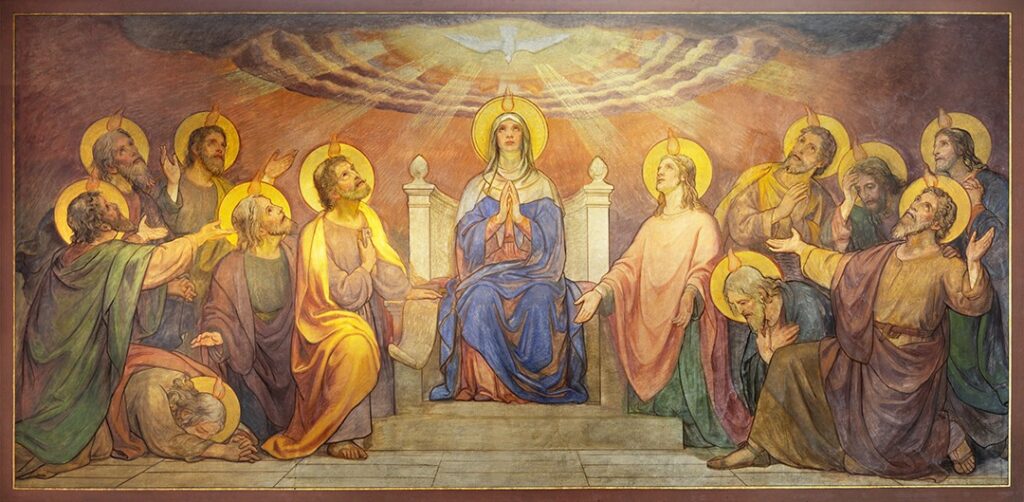
The liturgical celebration of Pentecost is not merely a remembrance of the outpouring of the Holy Spirit on Mary and the apostles in the Cenacle in the past, but the actual realization of the Event, in which God the Father, “in his Word who became incarnate, died, and rose for us, he fills us with his blessings. Through his Word, he pours into our hearts the Gift that contains all gifts, the Holy Spirit” (Catechism of the Catholic Church 1082). It is about the mystery that is also fulfilled now in those who celebrate it in faith. In this context, the readings and the Gospel of today’s Mass help us to understand and open ourselves even more to the gift of the Spirit that we receive in our lives as disciples, sent by Jesus to be his witnesses “to the ends of the earth.”
1. A Strong Driving Wind– A Mysterious Event and Eventful Mystery
What really happened with Jesus’ disciples on the day of Pentecost?
Firstly, as the reading from the Acts of the Apostles tells us, while “they were all in one place together,” that is, in the Cenacle, the “Upper Room”, “suddenly there came from the sky a noise like a strong driving wind, and it filled the entire house in which they were.” The emphasis on the words “noise,” and “strong driving wind,” seems to go beyond the physical description of a weather phenomenon. Such a strong wind was mentioned at key moments in biblical history: in the night of creation, with “a mighty wind sweeping over the waters” of chaos, where the Hebrew expression can also mean “the Spirit of God” (cf. Gn 1:2); on the night of the Red Sea crossing, there was a “strong east wind all night long,” which separated the waters of the sea into two walls to leave a dry ground for God’s people (cf. Ex 14:21-23); in the vision prophet Ezekiel’s vision, the four winds come, which are the Spirit of God, the dead bones of the people come to life again (cf. Ez 37:9-14). Thus, as seen in the past, on this day of Pentecost came a strong driving wind that heralds a pivotal event in the salvation history of humankind, an event that brings a new creation, liberation, resurrection of humanity.
Secondly, on the other hand, as the Catechism of the Catholic Church explains, “The term ‘Spirit’ translates the Hebrew word ruah, which, in its primary sense, means breath, air, wind. Jesus indeed uses the sensory image of the wind to suggest to Nicodemus the transcendent newness of him who is personally God’s breath, the divine Spirit” (Catechism of the Catholic Church 691). Thus, in the wind we can glimpse the Spirit in action, or rather, His “descent” from heaven. We must feel all this, in heart and mind, to enter with fear and trembling into the solemn and grandiose atmosphere of the moment and to relive the mystery of Pentecost in all its fullness.
2. Tongues as of Fire – The Mystery of the Outpouring of the Spirit
After the noise, “appeared to them tongues as of fire, which parted and came to rest on each one of them.” Here is the moment of the outpouring of the Holy Spirit, as it is explained immediately afterwards, “And they were all filled with the Holy Spirit.” However, an interesting detail should be pointed out: what did the apostles see at that moment? Flames of fire over their heads, as we usually see in various paintings in churches? No, the sacred author was subtle in his description of what happened: not “tongues of fire,” but “tongues as of fire”, where the meaning of the word “as” is precisely “as, like,” and not instead “equal, exactly the same!” Again, one must keep this in mind to understand that we are dealing with an unspeakable, inscrutable mystery, and any description will always be approximate. (After all, if there had really been fire on their heads, their hair would have all burned off!). On the other hand, one wants to associate the visible image of fire with the invisible reality of the Spirit with which “they were all filled.” As the Catechism said again, “While water signifies birth and the fruitfulness of life given in the Holy Spirit, fire symbolizes the transforming energy of the Holy Spirit’s actions. […] John the Baptist […] proclaims Christ as the one who ‘will baptize you with the Holy Spirit and with fire (Lk 1:17; 3:16).’ Jesus will say of the Spirit: ‘I came to cast fire upon the earth; and would that it were already kindled! (Lk 12:49)’ In the form of tongues ‘as of fire,’ the Holy Spirit rests on the disciples on the morning of Pentecost and fills them with himself (Acts 2:3-4). The spiritual tradition has retained this symbolism of fire as one of the most expressive images of the Holy Spirit’s actions. ‘Do not quench the Spirit’ (1 Thess 5:19).” (Catechism of the Catholic Church 696). The Spirit is the fire that transforms life, enlightens the mind, and makes love for God burn in the heart.
3. The Holy Spirit “Will Teach You Everything”
Descending on the apostles, the Holy Spirit immediately enabled them to “speak in different tongues” to everybody “of the mighty acts of God.” It is almost a fulfillment of what Jesus had told his disciples at the Last Supper, as today’s Gospel reminds us, “The Advocate, the Holy Spirit whom the Father will send in my name, will teach you everything.” From the Catechism we know that, “When he proclaims and promises the coming of the Holy Spirit, Jesus calls him the ‘Paraclete,’ literally, ‘he who is called to one’s side,’ advocatus (Jn 14:16, 26; 15:26; 16:7). ‘Paraclete’ is commonly translated by ‘consoler,’ and Jesus is the first consoler. The Lord also called the Holy Spirit ‘the Spirit of truth’ (Jn16:13).” (Catechism of the Catholic Church 692). Moreover, “everything” that the Spirit will teach certainly does not refer to all the possible knowledge in the world, but to the knowledge of God and Christ and the ability to proclaim to others the divine truths, revealed in Christ, for their salvation. So much so that, after “[the Holy Spirit] will teach you everything” it follows at the conclusion of the thought “and remind you of all that I told you.”
To better understand the Jesus’ words about the role of the Spirit it is worth recalling the authoritative teaching of St. John Paul II in his Encyclical Dominum et vivificantem:
The Holy Spirit will be the Counselor of the Apostles and the Church, always present in their midst-even though invisible-as the teacher of the same Good News that Christ proclaimed. The words “he will teach” and “bring to remembrance” mean not only that he, in his own particular way, will continue to inspire the spreading of the Gospel of salvation but also that he will help people to understand the correct meaning of the content of Christ’s message; they mean that he will ensure continuity and identity of understanding in the midst of changing conditions and circumstances. The Holy Spirit, then, will ensure that in the Church there will always continue the same truth which the Apostles heard from their Master.
Thus, the Holy Spirit continues in the Church and in Christ’s disciples the mission of God. As Pope Francis also mentioned, “it was precisely following the descent of the Holy Spirit on the disciples that the first act of witnessing to the crucified and risen Christ took place. That kerygmatic proclamation – Saint Peter’s “missionary” address to the inhabitants of Jerusalem – inaugurated an era in which the disciples of Jesus evangelized the world. Whereas they had previously been weak, fearful and closed in on themselves, the Holy Spirit gave them the strength, courage and wisdom to bear witness to Christ before all.” Moreover, Pope Francis further explained, “Just as “no one can say ‘Jesus is Lord,’ except by the Holy Spirit” (1 Cor 12:3), so no Christian is able to bear full and genuine witness to Christ the Lord without the Spirit’s inspiration and assistance. All Christ’s missionary disciples are called to recognize the essential importance of the Spirit’s work, to dwell in his presence daily and to receive his unfailing strength and guidance. Indeed, it is precisely when we feel tired, unmotivated or confused that we should remember to have recourse to the Holy Spirit in prayer. Let me emphasize once again that prayer plays a fundamental role in the missionary life, for it allows us to be refreshed and strengthened by the Spirit as the inexhaustible divine source of renewed energy and joy in sharing Christ’s life with others” (Message for World Mission Sunday 2022)
Let us pray that all of us, missionary disciples of Christ, may experience Pentecost well, indeed fully, today, and that it will give us new impetus to continue Christ’s mission in the power of the Spirit. This is especially true for those who directly engage in mission and missionary animation as in the Pontifical Mission Societies. Blessed Paolo Manna, when planning to found the Missionary Union of Clergy, which later became the present Pontifical Missionary Union, had a clear vision, “an authentic, genuine, missionary movement must be above all spiritual, since it is the work of the Holy Spirit; it must be a Pentecost: then, and only then, will it convince, penetrate, sanctify, inspire and leave lasting fruits of prayer, works, sacrifices; only then will true missionary vocations flourish” (Le Missioni Cattoliche LX [1931], 24 may, p. 323ff.) Mary, Mother of the Church and Queen of Missions, pray for us all and for the whole Church!
USEFUL POINTS TO CONSIDER:
1. Pope Leo XIV, Vigil of Pentecost, Homily, St. Peter’s Square, Saturday, 7 June 2025
[…] The Spirit of Jesus changes the world because he changes hearts. The Spirit inspires the contemplative dimension of life that rejects self-assertion, complaining, rivalry and the temptation to control consciences and resources. The Lord is the Spirit, and where the Spirit of the Lord is, there is freedom (cf. 2 Cor 3:17). An authentic spirituality thus commits us to integral human development, to making Jesus’ words a reality in our lives. When this happens, there is always joy: joy and hope.
Evangelization, dear brothers and sisters, is not our attempt to conquer the world, but the infinite grace that radiates from lives transformed by the Kingdom of God. It is the way of the Beatitudes, a path that we tread together, between the “already” and the “not yet,” hungering and thirsting for justice, poor in spirit, merciful, meek, pure of heart, men and women of peace. Jesus himself chose this path: to follow it, we have no need of powerful patrons, worldly compromises, or emotional strategies. Evangelization is always God’s work. If at times it takes place through us, it is thanks to the bonds that it makes possible. So be deeply attached to each of the particular Churches and parish communities in which you cultivate and exercise your charisms. Together with the bishops and in cooperation with all the other members of the Body of Christ, all of us will then work together harmoniously as one. The challenges facing humanity will be less frightening, the future will be less dark and discernment will be less complicated… if together we obey the Holy Spirit! […]
2. Pope Leo XIV, Holy Mass on the Solemnity of Pentecost, Jubilee of Movements, Associations and New Communities, Papal Chapel, Homily, St. Peter’s Square, Sunday, 8 June 2025
[…] As we heard in the first reading, the Spirit accomplished something extraordinary in the lives of the Apostles. Following Jesus’ death, they had retreated behind closed doors, in fear and sadness. Now they receive a new way of seeing things, an interior understanding that helps them to interpret the events that occurred and to experience intimately the presence of the Risen Lord. The Holy Spirit overcomes their fear, shatters their inner chains, heals their wounds, anoints them with strength and grants them the courage to go out to all and to proclaim God’s mighty works. […]
The Spirit opens borders, first of all, in our hearts. He is the Gift that opens our lives to love. His presence breaks down our hardness of heart, our narrowness of mind, our selfishness, the fears that enchain us and the narcissism that makes us think only of ourselves. The Holy Spirit comes to challenge us, to make us confront the possibility that our lives are shrivelling up, trapped in the vortex of individualism. Sadly, oddly enough, in a world of burgeoning “social” media, we risk being ever more alone. Constantly connected, yet incapable of “networking”. Always immersed in a crowd, yet confused and solitary travellers.
The Spirit of God allows us to find a new way of approaching and experiencing life. He puts us in touch with our inmost self, beneath all the masks we wear. He leads us to an encounter with the Lord by teaching us to experience the joy that is his gift. He convinces us, as we just heard in Jesus’ words, that only by abiding in love, will we receive the strength to remain faithful to his word and to let it transform us. The Spirit opens our interior borders, so that our lives can become places of welcome and refreshment.
The Spirit also opens borders in our relationship with others. Jesus tells us that this Gift is the love between him and the Father that comes to dwell within us. We then become capable of opening our hearts to our brothers and sisters, overcoming our rigidity, moving beyond our fear of those who are different, and mastering the passions that stir within. […] In this way, the Spirit broadens the borders of our relationships and opens us to the joy of fraternity. This is also a critical yardstick for the Church. For we are truly the Church of the Risen Lord and disciples of Pentecost if there are no borders or divisions among us; if we are able to dialogue and accept one another in the Church, and to reconcile our diversities; and if, as Church, we become a welcoming and hospitable place for all.
Finally, the Spirit also opens borders between peoples. At Pentecost, the Apostles spoke the languages of those they met, and the confusion of Babel was finally resolved by the harmony brought about by the Spirit. Whenever God’s “breath” unites our hearts and makes us view others as our brothers and sisters, differences no longer become an occasion for division and conflict but rather a shared patrimony from which we can all draw, and which sets us all on journey together, in fraternity.
The Spirit breaks down barriers and tears down the walls of indifference and hatred because he “teaches us all things” and “reminds us of Jesus’ words” (cf. Jn 14:26). He teaches us, reminds us, and writes in our hearts before all else the commandment of love that the Lord has made the center and summit of everything. […]
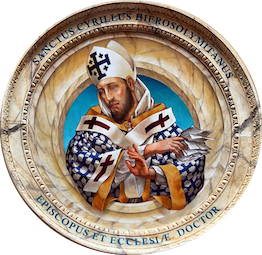
3. From a catechetical instruction by Saint Cyril of Jerusalem, bishop (Cat. 16, De Spiritu Sancto 1, 11-12.16: PG 33, 931-935. 939-942)
The living water of the Holy Spirit
The water that I shall give him will become in him a fountain of living water, welling up into eternal life. This is a new kind of water, a living, leaping water, welling up for those who are worthy. But why did Christ call the grace of the Spirit water? Because all things are dependent on water; plants and animals have their origin in water. Water comes down from heaven as rain, and although it is always the same in itself, it produces many different effects, one in the palm tree, another in the vine, and so on throughout the whole of creation. It does not come down, now as one thing, now as another, but while remaining essentially the same, it adapts itself to the needs of every creature that receives it.
In the same way the Holy Spirit, whose nature is always the same, simple and indivisible, apportions grace to each man as he wills. Like a dry tree which puts forth shoots when watered, the soul bears the fruit of holiness when repentance has made it worthy of receiving the Holy Spirit. Although the Spirit never changes, the effects of this action, by the will of God and in the name of Christ, are both many and marvelous.
The Spirit makes one man a teacher of divine truth, inspires another to prophesy, gives another the power of casting out devils, enables another to interpret Holy Scripture. The Spirit strengthens one man’s self-control, shows another how to help the poor, teaches another to fast and lead a life of asceticism, makes another oblivious to the needs of the body, trains another for martyrdom. His action is different in different people, but the Spirit himself is always the same. In each person, Scripture says, the Spirit reveals his presence in a particular way for the common good.
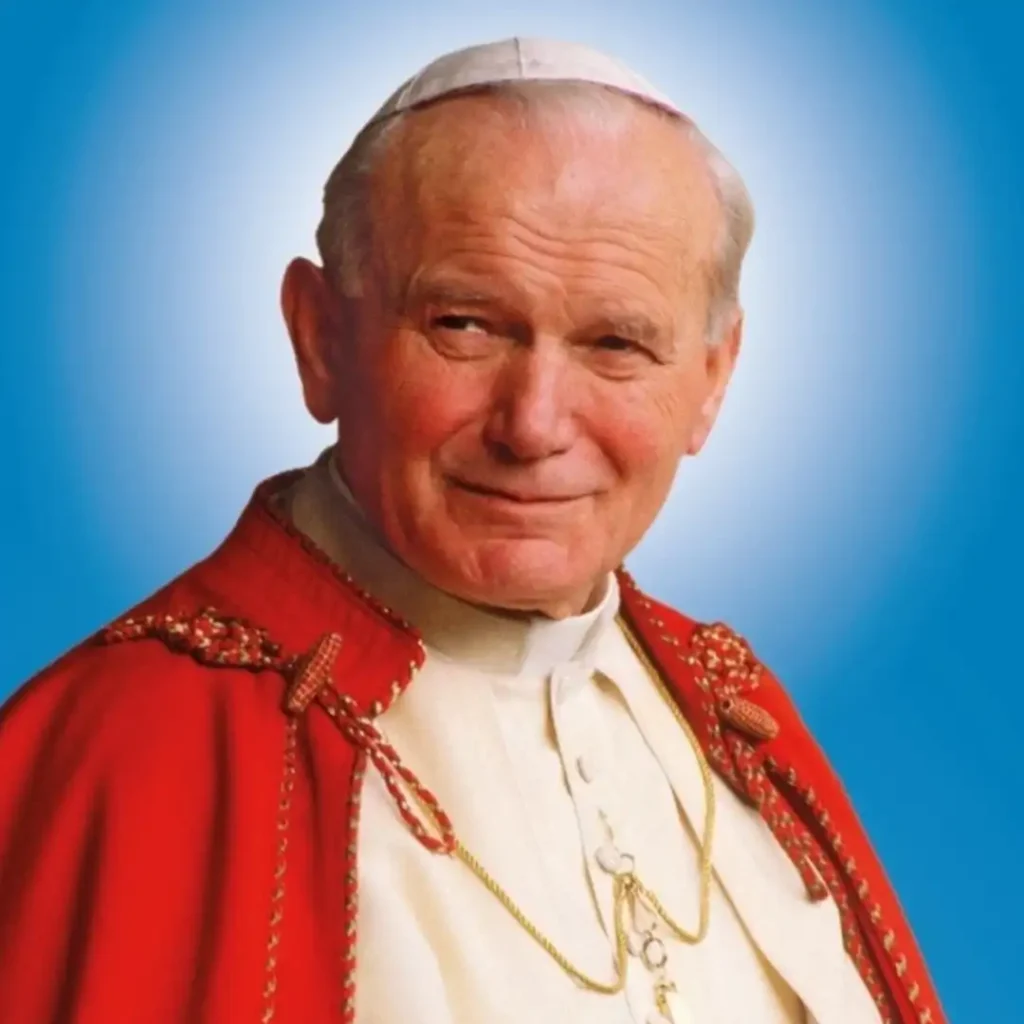
4. John Paul II, Encyclical on the Holy Spirit in the Life of the Church and the World, Dominum et Vivificantem (25)
“Having accomplished the work that the Father had entrusted to the Son on earth (cf. Jn 17:4), on the day of Pentecost the Holy Spirit was sent to sanctify the Church forever, so that believers might have access to the Father through Christ in one Spirit (cf. Eph 2:18). He is the Spirit of life, the fountain of water springing up to eternal life (cf. Jn 4:14; 7:38ff.), the One through whom the Father restores life to those who are dead through sin, until one day he will raise in Christ their mortal bodies” (cf. Rom 8:10f.). In this way the Second Vatican Council speaks of the Church’s birth on the day of Pentecost. This event constitutes the definitive manifestation of what had already been accomplished in the same Upper Room on Easter Sunday. The Risen Christ came and “brought” to the Apostles the Holy Spirit. He gave him to them, saying “Receive the Holy Spirit.” What had then taken place inside the Upper Room, “the doors being shut,” later, on the day of Pentecost is manifested also outside, in public.
5. Catechism of the Catholic Church
737 The mission of Christ and the Holy Spirit is brought to completion in the Church, which is the Body of Christ and the Temple of the Holy Spirit. This joint mission henceforth brings Christ’s faithful to share in his communion with the Father in the Holy Spirit; the Spirit prepares men and goes out to them with his grace, in order to draw them to Christ; the Spirit manifests the risen Lord to them, recalls his word to them and opens their minds to the understanding of his Death and Resurrection. He makes present the mystery of Christ, supremely in the Eucharist, in order to reconcile them, to bring them into communion with God, that they may “bear much fruit.”
738 Thus the Church’s mission is not an addition to that of Christ and the Holy Spirit, but is its sacrament: in her whole being and in all her members, the Church is sent to announce, bear witness, make present, and spread the mystery of the communion of the Holy Trinity: All of us who have received one and the same Spirit, that is, the Holy Spirit, are in a sense blended together with one another and with God. For if Christ, together with the Father’s and his own Spirit, comes to dwell in each of us, though we are many, still the Spirit is one and undivided. He binds together the spirits of each and every one of us,… and makes all appear as one in him. For just as the power of Christ’s sacred flesh unites those in whom it dwells into one body, I think that in the same way the one and undivided Spirit of God, who dwells in all, leads all into spiritual unity.